
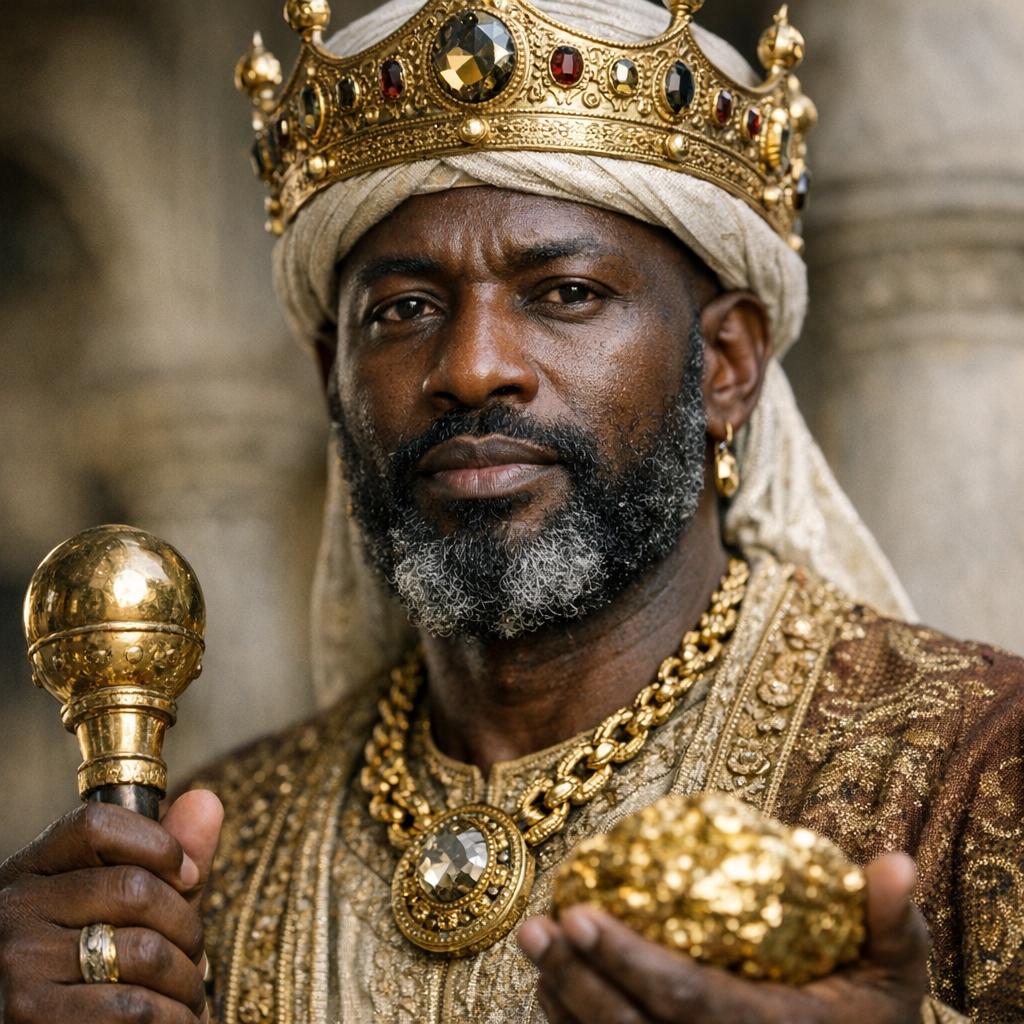
Mansa Musa
Born: c. 1280
Known for: Ninth Mansa of the Mali Empire.
Died: c. 1337
Age: 57
Allegiance: Musa's reign is often regarded as the zenith of Mali's power and prestige.
Conflicts: The Conquest of Gao: While Musa was on his pilgrimage in 1324, one of his leading generals extended the empire's reach by capturing Gao, the capital of the Songhai kingdom.
Annexation of Timbuktu: Musa peaceably annexed Timbuktu in 1324 and later reinforced it with a stone fort and a permanent garrison after a brief invasion by the Mossi people in 1330.
24 Cities: Chroniclers note that Musa successfully conquered 24 cities and their surrounding districts, bringing the empire to its territorial zenith.
Cause of Death: The exact cause of Mansa Musa's death is unknown because no primary historical records or accounts from the 14th century specify how he died. Most historians believe he died of natural causes around 1337, likely in his mid-50s.
Resting Place: The exact burial site of Mansa Musa is currently unknown, as there are no surviving historical records or archaeological evidence identifying his final resting place. While it is generally believed that he died in one of his royal palaces within the Mali Empire between 1332 and 1337, his grave has never been located.
Spouses: Inari Konte
Mansa Musa (c. 1280 – c. 1337) was the ninth Mansa of the Mali Empire, which reached its territorial peak during his reign. Musa's reign is often regarded as the zenith of Mali's power and prestige, although he features less in Mandinka oral traditions than his predecessors.
Musa was exceptionally wealthy, to an extent that contemporaries described him as inconceivably rich; Time magazine reported: "There's really no way to put an accurate number on his wealth." It is known from local manuscripts and travellers' accounts that Mansa Musa's wealth came principally from the Mali Empire's control and taxing of the trade in salt from northern regions and especially from gold panned and mined in Bambuk and Bure to the south. Over a very long period Mali had amassed a large reserve of gold. Mali is also believed to have been involved in the trade in many goods such as ivory, slaves, spices, silks, and ceramics. However, presently little is known about the extent or mechanics of these trades. It is estimated that two thirds of the gold circulating in the Medieval Mediterranean came from West Africa. At the time of Musa's ascension to the throne, Mali consisted largely of the territory of the former Ghana Empire, which had become a vassal of Mali. The Mali Empire comprised land that is now part of Guinea, Senegal, Mauritania, the Gambia, and the modern state of Mali.
Musa went on Hajj to Mecca in 1324, traveling with an enormous entourage and a vast supply of gold. En route he spent time in Cairo, where his lavish gift-giving is said to have noticeably affected the value of gold in Egypt and garnered the attention of the wider Muslim world. Musa expanded the borders of the Mali Empire, in particular incorporating the cities of Gao and Timbuktu into its territory. He sought closer ties with the rest of the Muslim world, particularly the Mamluk and Marinid Sultanates. He recruited scholars from the wider Muslim world to travel to Mali, such as the Andalusian poet Abu Ishaq al-Sahili, and helped establish Timbuktu as a center of Islamic learning. His reign is associated with numerous construction projects, including a portion of Djinguereber Mosque in Timbuktu.